Quest-ce que tu cherches?

La tuyauterie joue un rôle primordial dans les compresseurs d'air à vis. Une installation correcte garantit un fonctionnement optimal, et nous accordons une grande importance à ce processus. Connaissez-vous les points clés à prendre en compte ?
1. Conditions d'installation des compresseurs d'air à vis
(1) Les compresseurs d'air à vis doivent être installés sur un sol dur, et la surface de fondation doit être nivelée avant l'installation pour éviter le bruit causé par les vibrations du compresseur.
(2) Les compresseurs d'air à vis génèrent des vibrations minimales ; par conséquent, aucune fondation fixe n'est requise. Toutefois, le sol sur lequel ils sont installés doit être plat et exempt de terre meuble. Il est recommandé de placer une sous-couche souple de 5 à 10 mm ou un tapis anti-vibrations sous le compresseur afin de réduire les vibrations et le bruit.
(3) Si le compresseur d'air à vis est installé à un étage supérieur, un traitement anti-vibration doit être effectué pour empêcher la transmission des vibrations aux étages inférieurs ou la création d'une résonance, ce qui peut présenter des risques potentiels pour la sécurité du compresseur et du bâtiment lui-même.
2. Considérations clés pour la tuyauterie des compresseurs d'air à vis
(1) Lors de la pose de la conduite principale, une pente de 1° à 2° doit être maintenue afin de faciliter l'évacuation des condensats. La perte de charge dans la conduite ne doit pas excéder 5 % de la pression de tarage du compresseur ; il est donc conseillé d'opter pour un diamètre de conduite plus important lors de la construction.
(2) Les conduites de dérivation doivent être raccordées en haut de la conduite principale afin d'empêcher l'eau condensée présente dans cette dernière de s'écouler dans les équipements en fonctionnement. Il est préférable d'installer un clapet anti-retour sur la conduite de sortie d'air du compresseur.
(3) Une vanne à bille doit être installée à l'extrémité de la conduite principale pour faciliter l'évacuation de l'eau condensée.
(4) Ne réduisez pas arbitrairement le diamètre de la conduite principale. Si une réduction ou une dilatation du diamètre est inévitable, utilisez des conduites coniques. Dans le cas contraire, un écoulement mixte se produira aux joints, entraînant une perte de charge importante et réduisant la durée de vie de la conduite.
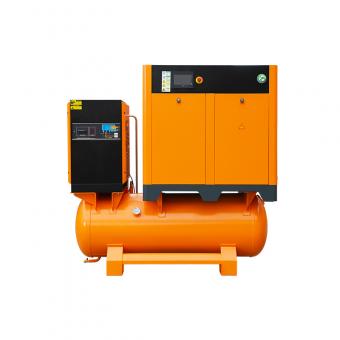
(5) Si le compresseur est équipé d'un système de stockage et de purification d'air, tel qu'un réservoir d'air comprimé et un sécheur, la configuration de tuyauterie idéale est la suivante : Compresseur + Séparateur air-eau + Réservoir d'air comprimé + Préfiltre + Sécheur + Postfiltre + Filtre de précision. Ainsi, le réservoir d'air comprimé filtre une partie de l'eau condensée et contribue à abaisser la température de l'air comprimé, réduisant ainsi la charge du sécheur et des filtres.
(6) Si le système présente une consommation d'air instantanée importante, un réservoir d'air tampon doit être installé (son volume doit être supérieur ou égal à 20 % du volume d'air instantané maximal). Ceci permet de réduire la fréquence des cycles de charge/décharge du compresseur et, par conséquent, les temps d'actionnement des composants de commande, ce qui contribue fortement à la fiabilité de fonctionnement du compresseur. En règle générale, un réservoir d'air d'un volume équivalent à 20 % de la cylindrée du compresseur peut être choisi.
(7) Pour l'air comprimé avec une pression système inférieure à 1,5 MPa, la vitesse d'écoulement dans la conduite de livraison doit être inférieure à 15 m/s pour éviter une chute de pression excessive.
(8) Minimiser l’utilisation de coudes et de vannes diverses dans la canalisation afin de réduire les pertes de pression.



 IPv6 réseau pris en charge
 English
 français
 Deutsch
 русский
 español
 português
 日本語
日本語 한국의
한국의 ไทย
ไทย 中文
中文